Picture this: You've just endured a two-hour bus ride through blistering heat and winding mountain roads. You finally arrive at the gates of a 12th-century temple, a masterpiece of ancient architecture that you've dreamed of seeing for years. You step forward, sweating in your tank top and shorts, only to have a guard cross his arms, point at your legs, and shake his head. Entry denied.
This is a rite of passage for many first-time visitors to Southeast Asia, but it doesn't have to be yours.
Southeast Asia is a region where the sacred and the mundane coexist seamlessly. You will find Buddhist shrines nestled between modern skyscrapers in Bangkok, and Hindu offerings lining the sidewalks of Bali. Because religion here is not just a Sunday activity but a living, breathing daily practice, temples are not merely tourist attractions; they are active places of worship, meditation, and spiritual power.
As a traveler, understanding how to navigate these spaces is the ultimate test of cultural respect. It is about shifting your mindset from "consumer of sights" to "honored guest." In this guide, we will break down the universal rules of temple etiquette across the region, the deep cultural philosophies behind them, and the specific nuances you need to know so you can explore these sacred spaces with confidence and grace.
The Universal Dress Code: Shoulders and Knees
If you remember only one rule from this entire guide, let it be this: Shoulders and knees must be covered. This applies to all genders, across almost all religious sites in Southeast Asia (Buddhist, Hindu, and Islamic).
Why Modesty Matters
In Western cultures, showing skin is often just a practical response to hot weather. In Asia, modesty is a physical manifestation of respect. Entering a temple with bare shoulders or short shorts is viewed as bringing the "impurity" and casualness of the outside world into a sacred, purified space. It is considered deeply offensive to the deity, the monks, and the local worshippers.
The "Elephant Pants" Hack
You will see them everywhere: the lightweight, breathable, ankle-length cotton pants adorned with elephant prints. They are sold on every street corner near tourist temples for a few dollars. Buy a pair. They are the ultimate travel hack because they keep your legs covered for temple entry while allowing maximum airflow in the sweltering tropical heat. Pair them with a lightweight linen shirt or a t-shirt that fully covers the shoulder joint (no racerbacks or spaghetti straps).
The Scarf Sarong Strategy
If you are caught off guard and wearing a sleeveless top, many major temples (like the Grand Palace in Bangkok or Angkor Wat in Cambodia) will rent or lend you a cover-up for a small fee or deposit. However, to avoid the hassle, always carry a lightweight sarong or a large scarf in your daypack. You can easily wrap it around your waist over shorts, or drape it over your shoulders before stepping through the threshold.
The Art of the Shoe: Taking Them Off (and Your Socks)
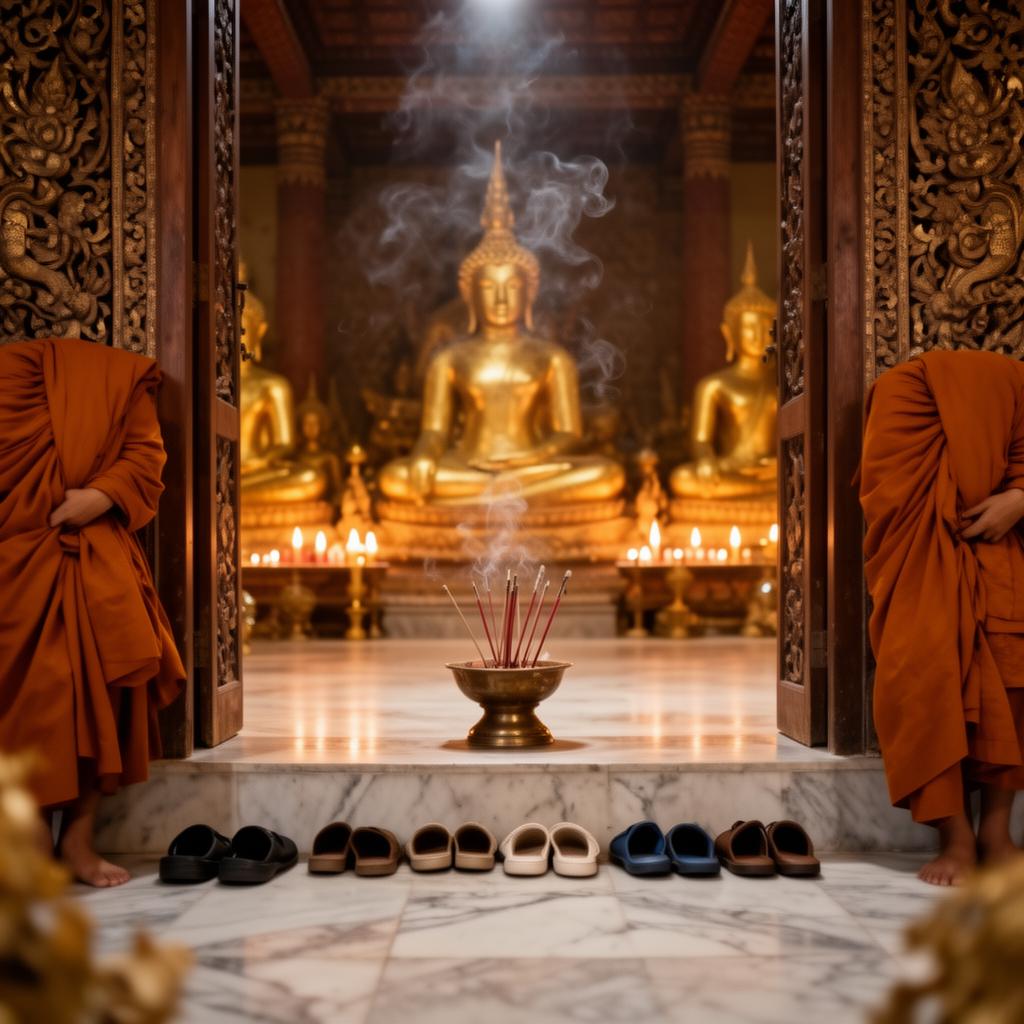
Before entering the main sanctuary of a Buddhist or Hindu temple, you must remove your shoes. This is non-negotiable. The floor of the inner sanctuary is considered highly sacred, and often, it is where people sit to meditate or pray. Bringing the dirt of the street onto that floor is a massive taboo.
Where to Put Them
Look for the massive piles of footwear at the entrance. Yes, you can leave your shoes there. However, if you have expensive sandals or hiking shoes, it is often safer to tuck them into a bush or a corner, or carry them in a plastic bag in your backpack. Shoe theft at popular temples is surprisingly common.
The Sock Dilemma
Do you take your socks off too? Yes. In Buddhist and Hindu traditions, the barefoot connection to the sacred floor is a sign of humility. Walking in socks is generally frowned upon and can be seen as disrespectful (or just a slip hazard on smooth marble). Get used to the feeling of hot marble or cool tile on your bare feet; it is part of the sensory experience of the temple.
Pro Tip: This is exactly why slip-on shoes are the ultimate Southeast Asia travel footwear. If you are lace-up sneakers, you will spend 20 minutes of your day crouching by the temple door, blocking the entrance while you tie and untie your laces.
Body Language: The Sacred and the Profane
In Southeast Asia, the human body is viewed through a spiritual hierarchy. This is particularly true in Theravada Buddhist countries like Thailand, Cambodia, Laos, and Myanmar. Understanding this hierarchy is crucial to avoiding accidental, deeply offensive gestures.
The Head is Sacred
The head is considered the highest and most spiritually pure part of the body. It is where the soul resides. Never touch a local person's head, not even to ruffle a child's hair. Furthermore, do not stand taller than a monk or a Buddha statue if you can avoid it, and never hang your bag on a hook that is higher than a monk's head.
The Feet are the Lowest
Conversely, the feet are the lowest, dirtiest, and most profane part of the body. This leads to the most common mistake made by Western tourists: Never point your feet at a Buddha statue, a monk, or an altar.
When you sit down on the floor of a temple, you must tuck your legs back behind you (the "mermaid" sit) or cross them neatly so the soles of your feet are pointing toward the door, not toward the sacred image. Pointing your feet at the Buddha is the equivalent of giving the middle finger in Western culture. It is a profound sign of disrespect.
Monks and Nuns
If you are lucky enough to interact with monks, there are strict rules. The most critical rule for female travelers: Women must never physically touch a Buddhist monk or hand something directly to them. If a woman needs to give an offering to a monk, she must place it on a table or cloth, or have a man hand it to him. This stems from the monastic vows (Vinaya) that govern their lives. Simply lower your head in a slight bow and offer a warm smile; that is more than enough.
Photography: Capturing the Moment Without Causing Offense
We live in the age of the viral travel photo, but the quest for the perfect Instagram shot has led to some incredibly disrespectful behavior in Asia. Remember: you are in a house of worship, not a photo studio.
The "Selfie with the Sacred" Boundary
It is generally acceptable to take photos of the architecture, the statues, and the murals. However, posing with your back turned to a Buddha statue (to get the statue in your selfie) is considered highly disrespectful in many cultures, as it implies you are turning your back on the enlightened one. Furthermore, climbing on sacred structures to get a better angle is a massive taboo. (Recall the global outrage when tourists posed provocatively on the ancient stairs of Cambodia's Angkor Wat or Indonesia's Borobudur). Keep your feet on the ground and your posture respectful.
Photographing Worshippers
Never shove a camera in the face of someone who is deep in prayer. If you want to capture the atmosphere, use a zoom lens from a distance. If you must get closer, make eye contact, smile, and gesture to your camera to ask for permission. If they nod, take the shot and show them the screen with a thank you. If they look away or shake their head, put the camera down immediately.
Flash and Tripods
Turn off your flash. The sudden burst of light in a dim, meditative hall is jarring and ruins the concentration of those praying. Additionally, tripods and large professional rigs often require special permits from the temple abbots. Stick to handheld shooting to keep a low profile.
Religious Nuances: Knowing the Difference
While the "shoulders and knees" rule is universal, the specific practices vary wildly depending on the dominant religion of the country you are visiting.
Theravada Buddhism (Thailand, Cambodia, Laos, Myanmar)
In these countries, you will see locals performing the "Wai" (Thailand) or the Sampeah (Cambodia)—pressing their palms together in a prayer-like gesture and bowing slightly. You can return this gesture to show respect. When entering the main hall (Vihara or Siem Reap), you will often see locals walking clockwise around the central shrine. Join in if you wish; it is a meditative practice called pradakshina.
For specific, up-to-date rules on major heritage sites, the Tourism Authority of Thailand and the official APSARA Authority (which manages Angkor Archaeological Park) provide excellent, strict guidelines on dress codes.
Mahayana Buddhism (Vietnam, parts of Malaysia)
In Vietnam, temples often blend Buddhism with Taoism and the veneration of local ancestors. You will see locals burning incense and burning "joss paper" (paper money or goods) to send to the spirit world. The dress code is the same, but the atmosphere is often smokier and more fragrant. Do not walk directly through the smoke of the incense burners; walk around them.
Hinduism (Bali, Indonesia)
Bali is a unique Hindu enclave in the world's largest Muslim country. Balinese temples (Pura) require you to wear a sarong and a sash around your waist, which symbolizes the separation of the sacred upper body from the profane lower body. Most major temples rent these at the entrance.
Radical Transparency Note: In strict Balinese Hinduism, women who are menstruating are not permitted to enter the temple grounds, as blood is considered spiritually impure. While enforcement varies depending on how touristy the temple is, you should be aware of this rule, respect it, and not attempt to sneak in or argue with the priests if you are asked to wait outside.
For a deep dive into Balinese spiritual customs, the Official Bali Tourism Board offers great resources on respecting the island's unique daily offerings (Canang sari) and temple rituals.
Islam (Mosques in Malaysia, Indonesia, Brunei)
When visiting a mosque, the rules shift slightly. Both men and women must cover their legs and arms. Additionally, women are usually required to cover their hair with a headscarf (hijab). Many major mosques, like the stunning National Mosque in Kuala Lumpur, provide complimentary robes and scarves for tourists to borrow at the entrance. Before entering, you must perform a minor ablution (washing your hands and feet) at the provided fountains. Walk quietly, keep your voice to a whisper, and never walk directly in front of someone who is praying on their mat.
The Final Verdict: Respect is the Ultimate Souvenir
It is easy to feel overwhelmed by the sheer number of rules. Take off your shoes, cover your knees, don't point your feet, lower your voice, ask before you shoot. But once you internalize the philosophy behind them, it becomes second nature.
The rules of temple etiquette in Southeast Asia are not designed to make your life difficult; they are designed to create an environment of peace, humility, and spiritual focus. When you dress modestly, you signal to the locals that you see their sacred space as something more than just a backdrop for your vacation.
And the reward for this respect? It is immeasurable. It is the warm, genuine smile of a monk who nods at your polite demeanor. It is the quiet, profound sense of peace you feel when you sit barefoot on the cool marble, watching the incense curl toward the ceiling, knowing you are exactly where you are supposed to be: an honored guest in the heart of Asia.
About the author
Maya Torres
Maya is a Filipino-American travel writer whose journeys through the Philippines and broader Asia are deeply personal. Her focus is on heritage travel, cultural etiquette, and the vital role that language plays in breaking down barriers. Maya writes extensively about how learning even a few phrases of the local language can completely transform a traveler's experience, turning strangers into friends. She is a passionate advocate for sustainable, respectful tourism that gives back to local communities.